Clark Hoffman: Someone Special on the Line
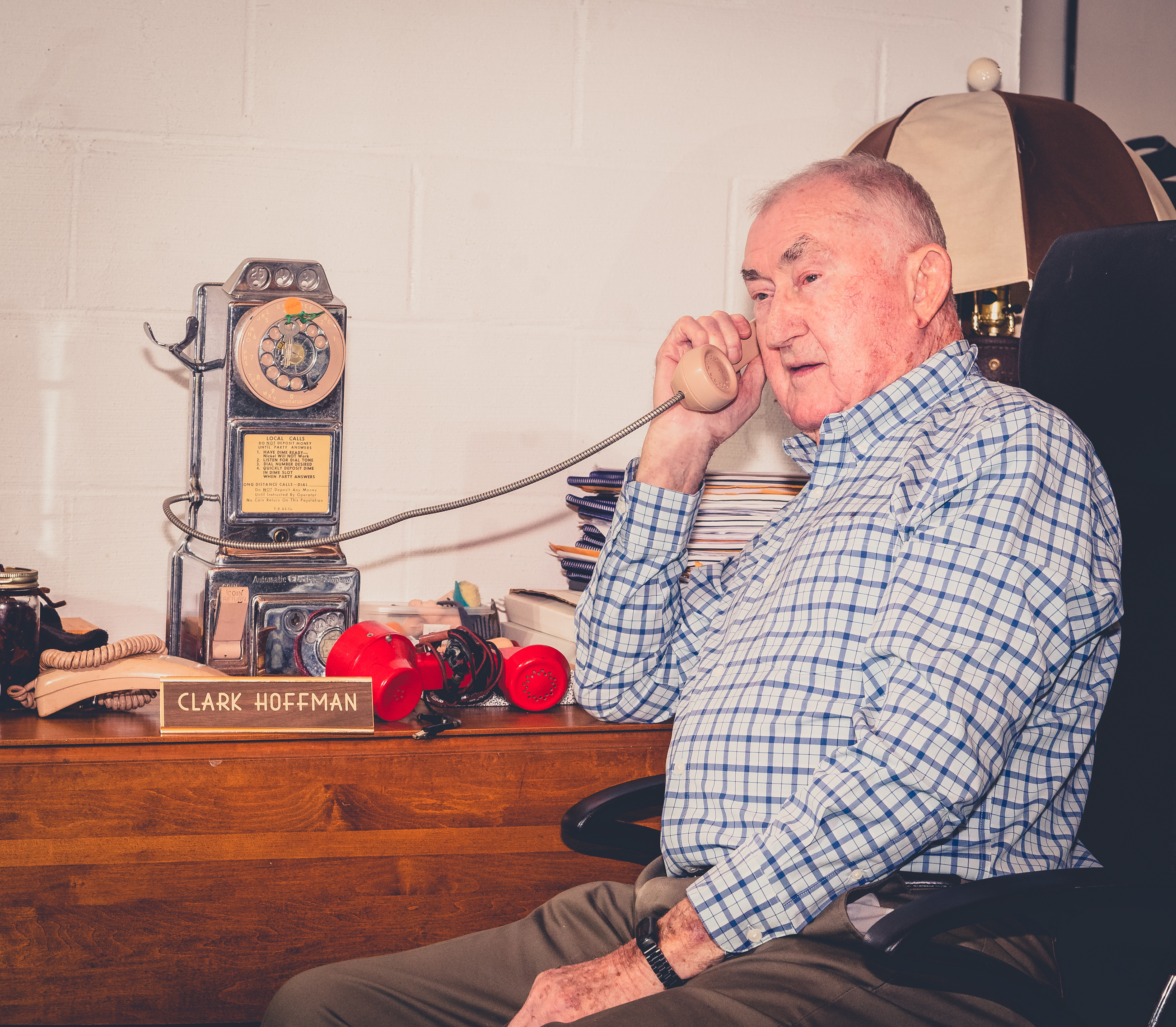
A memento from work.
In 1961, when Clark Hoffman was 21 and starting out in the telephone business in Chardon, Ohio, he worked outdoors, on a two-man line crew. This included putting up new telephone poles—digging the holes by hand, setting the poles by hand. “It’s a wonder we didn’t kill each other,” he says, laughing.
“You put cement in there?”
“No. Just dirt and a deep hole. Every five feet of pole, you went down another foot.”
“And then you’d just climb up?
"Yeah. No bucket truck, just hooks and a belt. You needed both hands free to work, so you’d climb up there, belt in, and lean back.”
If you were making a movie of this man’s life—a movie I’d pay money to see—you might open with this scene. It marks the beginning of a forty-year career, a steady climb up and up through the ranks at Chardon Telephone Company, then Mid-Continent Telephone, eventually bringing Clark to Meadville in 1990, as Executive V.P. of Operations at Alltel (the phone company that is now Kinetic). It’s an ascent of his own making, but one with a deep foundation.
Clark grew up on the family’s dairy farm near Somerset, PA, 70 miles southeast of Pittsburgh. You can still hear his origins when he speaks—he says things like “vee-hickle,” and “daggone.” One of five kids, he worked on the farm with his two brothers up through high school (a 7-mile walk from their house). His sisters did too, then got jobs at a turnpike restaurant near Somerset. Their mother kept the home going, and their father, Clark Sr., split his time between the farm and his job as a coal miner. As a way of life, it was physically demanding and relentless, with no frills and little room for what now gets called “self-care,” but, like the best versions of tough love, it has been a lifelong gift. “Mom and Dad taught us right from wrong. And when the church doors opened, you knew where your butt was. In the pew.”
Many of the through-lines in Clark’s life reach back to Somerset. He got his job at Chardon Telephone when the plant superintendent interviewing him asked where he was from and what his father did. When he heard the answer, he told Clark, “you can start Monday.” He knew a work ethic when he saw it.
Clark hadn’t set out to be in the telephone business. After high school, at the age of 17, he moved to Chardon, where his sister Jean had moved after she married, and got an assembly line job at GM. The work wasn’t steady, though. When he heard from a neighbor that Chardon Telephone was looking for people, he thought, why not? He took to the job, partly because he had worked on all sorts of equipment on the farm. He did get some specific training for his phone work through technical courses, but beneath that lay plenty of handyman confidence. After you’ve torn apart and reassembled a car at 15, installing phone lines or fixing the call processing equipment in the main office isn’t very daunting. Working up on those poles hadn’t been a problem, either. As a kid, when he wasn’t working, at school, or in church, he’d be in the woods with a buddy, playing in the treetops. In general Clark seems to have entered adulthood hard to daunt, equipped to keep his balance.
He also took to his job, at every stage, because he took to people. After he retired, that’s what he missed, the people. He has always been, as he put it, “kinda outgoing.” The man is so genial, so playful and obliging, it’s easy to miss his sharp, confident, farm-tough side. He’ll josh anywhere. When he ushers at his church and hands out bulletins before services, he’s likely to tell you, “three dollars for the regular, five for large print.” On a recent Sunday, when an older congregant—in other words, Clark’s age—told him she was having balance problems that morning, he suggested she ought not get into the whiskey that early. “I’ve never let things get to me,” he told me. Being with him gives a person the same little lift. Once, back in 1990, at the end of Clark’s big interview for the Alltel job, the company president stopped him.
“I want to tell you something, Clark. You’re the most relaxed person I’ve ever interviewed.”
Clark’s response was mighty relaxed. “Listen, don’t take this the wrong way,” he told the exec, “but I don’t care. I’m happy where I’m at right now. If you want me for the job, that’s fine. If you don’t, thank you for the interview.” Who wouldn’t hire a person like that?
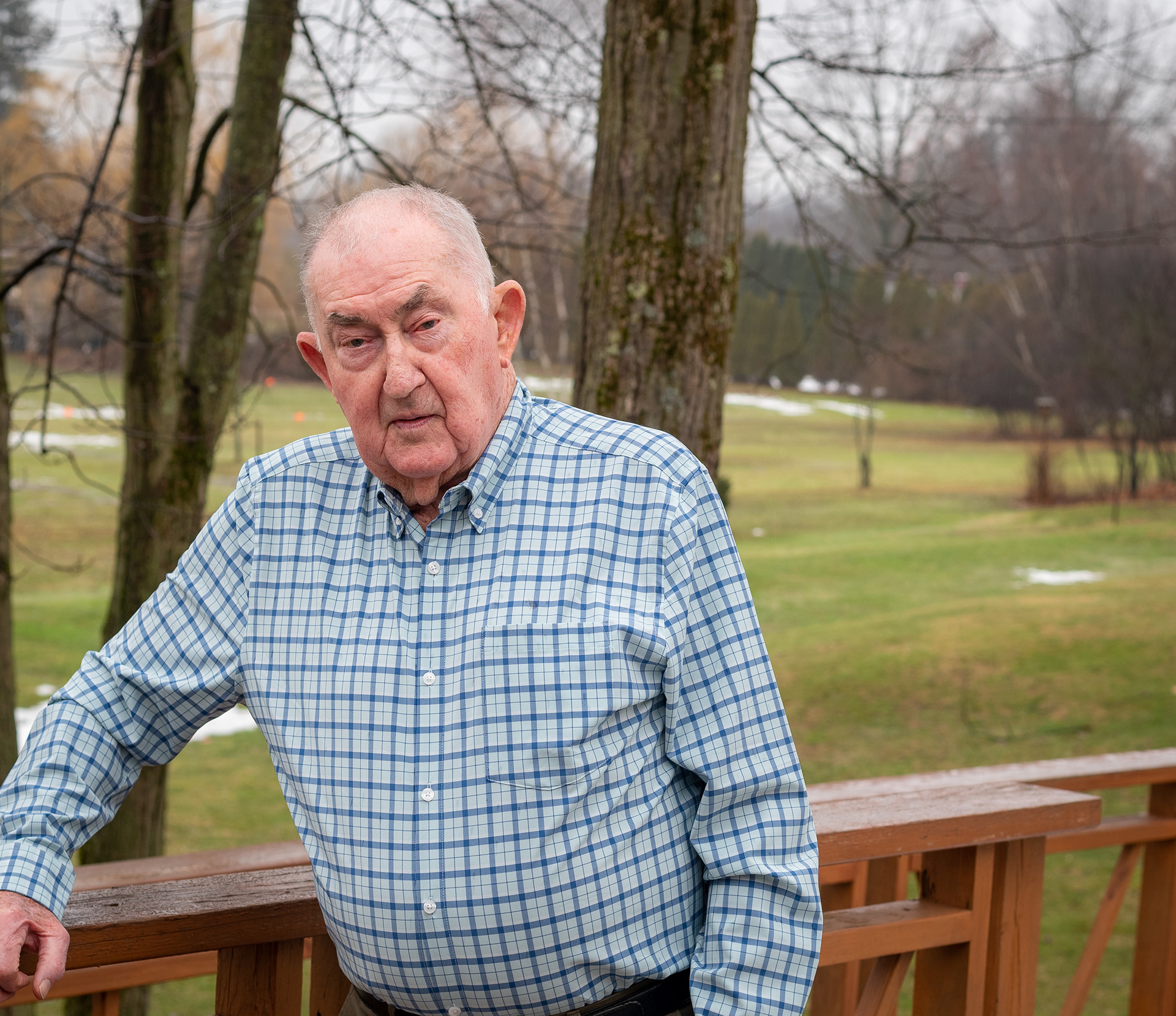
"As a kid, when he wasn't working, at school, or in church, he'd be in the woods with a buddy, playing in the treetops."
Almost from the start, Clark’s personable nature overflowed the bounds of his career, leading him to decades and decades of community work and leadership. Two years into his job in Chardon, he joined the local police force, working nights to supplement his modest income, but also to help the town function. In Kenton, Ohio, where he and his wife Carole moved after 28 years in Chardon, he helped start the READ program, an adult literacy service that changes lives. He was later president of Crawford County’s READ program as well. The list of Clark’s civic commitments in Meadville is as long as a telephone pole. He’s been president of the local United Way, president of the Meadville Medical Center Foundation and Operations boards, board president at Active Aging, president of his church council, president of the old Meadville Area Industrial Council, the local Chamber of Commerce, the Greendale Cemetery board, the board of the Crawford County Historical Society. (He remembers one Saturday when he got prison inmates on work-release to help him and two friends move old railroad equipment from the second floor of one downtown building to another.) If you thought “pillar of the community” was a defunct cliché, think again.
The significance of Clark’s work in the world has not been lost on others. In 1989 he received a President’s Award from the corporation that owned Alltel—one of five recipients, internationally (out of 20,000 candidates), in recognition of his company’s success. In Meadville he has received both the Raymond Shafer Award for Distinguished Community Service and the Winslow Award for his “significant contribution to the economic growth of the greater Meadville area.” None of this makes him particularly comfortable. “I spent a lot of money to buy those awards,” he quickly jokes. When he learned about the President’s Award, he was so surprised that his immediate reaction is unprintable.
From a certain angle, Clark Hoffman’s life seems like a classic story of American striving and American success. As he climbed, he stepped into the region’s transition from rural, agricultural life to an economy of advancing technologies. He was canny and pragmatic, decisive and trusted as a leader. But ambition has never seemed to be the point. He is doggedly modest. And he never climbed alone. There was his wife Carole and there were all those folks he worked with.
When I asked him why he thought he was successful, he said, “I believe in treating people the way you should treat people. It was never ‘I.’ It was ‘we.’ We accomplished a lot working together.”
Near the end of our conversation, fishing one last time for some statement about his accomplishments, I asked him what he was proudest of.
“My family. They are amazing to me.”
Carole passed away in 2019. “She was just a great person. I loved her dearly.” She had grown up on another farm in Somerset, and they met at a dance. “We hit it off pretty good.” Their three daughters, Chelley, Cindy, and Caren, were all born during the Chardon years. They have all gone on to build busy, accomplished lives. And they’re all very connected to Dad.
And now Clark is seeing a lovely lady from church. He had been handing out bulletins before services one Sunday, working his $3/$5 sales pitch. She made a little conversation, and he asked her, “would you have lunch with me?” As he tells me, “it just came out.” And she looked up at his face and said yes.
Of course she did. Clark Hoffman may be long retired but his company will always be worth keeping.
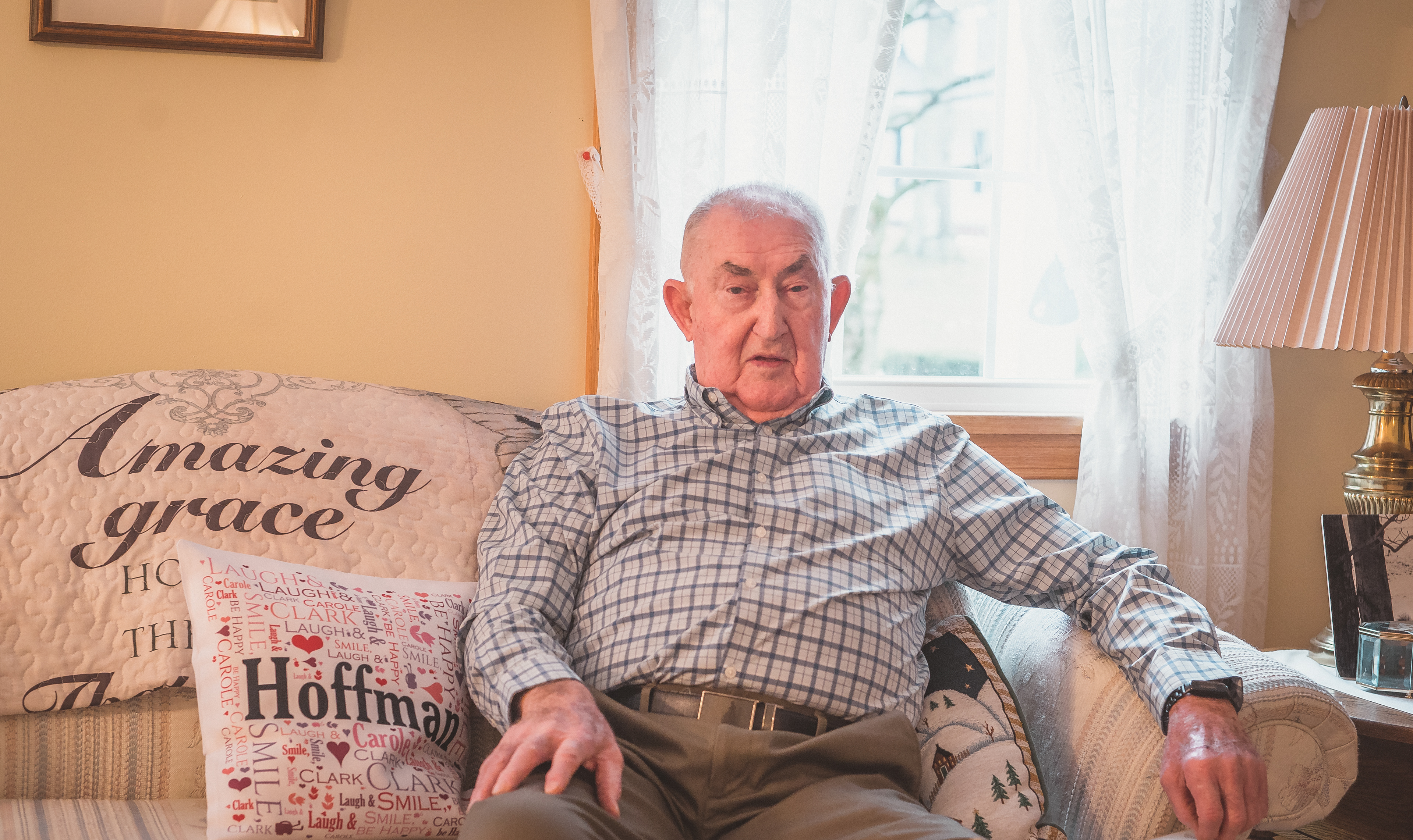
A man at home in his own skin.