Sam Pendolino: From North Street to Magistrate

How does a town with plenty of challenges hold itself together, day to day? In Meadville there are a hundred good answers, but I found a big one recently in the basement of the City Building, next to the police station. That’s where the town’s magisterial district court is located and where Sam Pendolino, the magisterial district judge of Meadville and West Mead Township, has presided these last ten years.
Every weekday brings to Sam and his four staff members a tide of civil and criminal conflict, big stuff and little stuff, serious criminal cases that will typically get advanced to the Judicial Center across Diamond Park, and any number of summary and other “lesser” offenses—retail theft, traffic violations, disorderly conduct, health code violations, landlord/tenant disputes. The full list is very long and adds up to a torrent of judicial labor, both in forms you’d expect, like criminal arraignments and bail hearings, and dozens of daily acts people don’t know about, including Sam’s efforts to connect “offenders” to the community services they often desperately need.
Ten minutes into my conversation with him, two things become clear: his job, as measured by volume, seems impossible; and he lives to do it, the way marathoners live to run.
Sam Pendolino emanates energy. In his late-50’s and a regular at the Allegheny gym, he moves and speaks with an intensity I associate with coaches. And when he addresses a subject, he covers the ground fully and in detail, a habit of mind well-suited to the sea of specifics that is the Commonwealth’s Criminal and Civil Rules of Court.
He’s no sentencing machine, though. “I don’t want to be known as the jerk,” he says. “I’m not here to make friends, to impress or possess. I’m here as a clean slate, to make judgement on what’s before the court, to provide the best judgement I can provide. I’m only human. A very limited human. And, if the law and the situation allow me, [I also] do what I can to help.”
Sam’s approach to his work—this combination of exacting integrity, humility, and kindness—owe a lot to his origins and his path to the bench.
He was born and raised in Meadville, the son of a mailman and a stay-at-home mom, and grew up in a modest house on North Street, right across from the high school football field. The youngest of three, he says he was the rule-breaker. “If the pleasure outweighed the punishment, I was all in. My mom would tell me, ‘Sammy, I said so many rosaries over you.’”
Beyond his immediate family, Sam had two centers of gravity as a kid: the neighborhood and St. Mary’s Catholic Church. “I loved growing up in Meadville.” The neighborhood “was loaded with kids,” and they played all sorts of games, usually in nearby Shadybrook Park— kick-the-can, wiffleball homerun derby. They’d improvise games. “We made it work,” he says. “We had to get called in at night.” It was an earlier era. All the kids at East End, his elementary school, could walk home for lunch because all their mothers were there. Years later, when Sam and his wife Christi bought their first house, they chose a place right behind his childhood home, where his folks still lived. Their backyards faced each other. “And my sister, Patti, lived right across the street from us.”
Going to mass extended his sense of family. Of the three Catholic churches in town, St. Mary’s was home to Meadville’s large Italian-American community. “It used to be packed,” he says, “300-plus people,” many, many of them relatives and friends. “That’s who we were connected with. Costas, Longos, Cervones, Pasillas, Barcos, Giontis, Rinellas. And on and on. That’s who we grew up with.” Sam’s mother (née Consiglio, Vallala on her mother’s side) taught Sunday school at St. Mary’s and later served on the Catholic Council. His father was born in a house across the street from the church. Sam’s great-aunt owned the house for years and would host enormous lunches every Sunday. “A whole multitude of us would cross the street after mass and stay at her home for hours.” He never knew how she produced all that food.
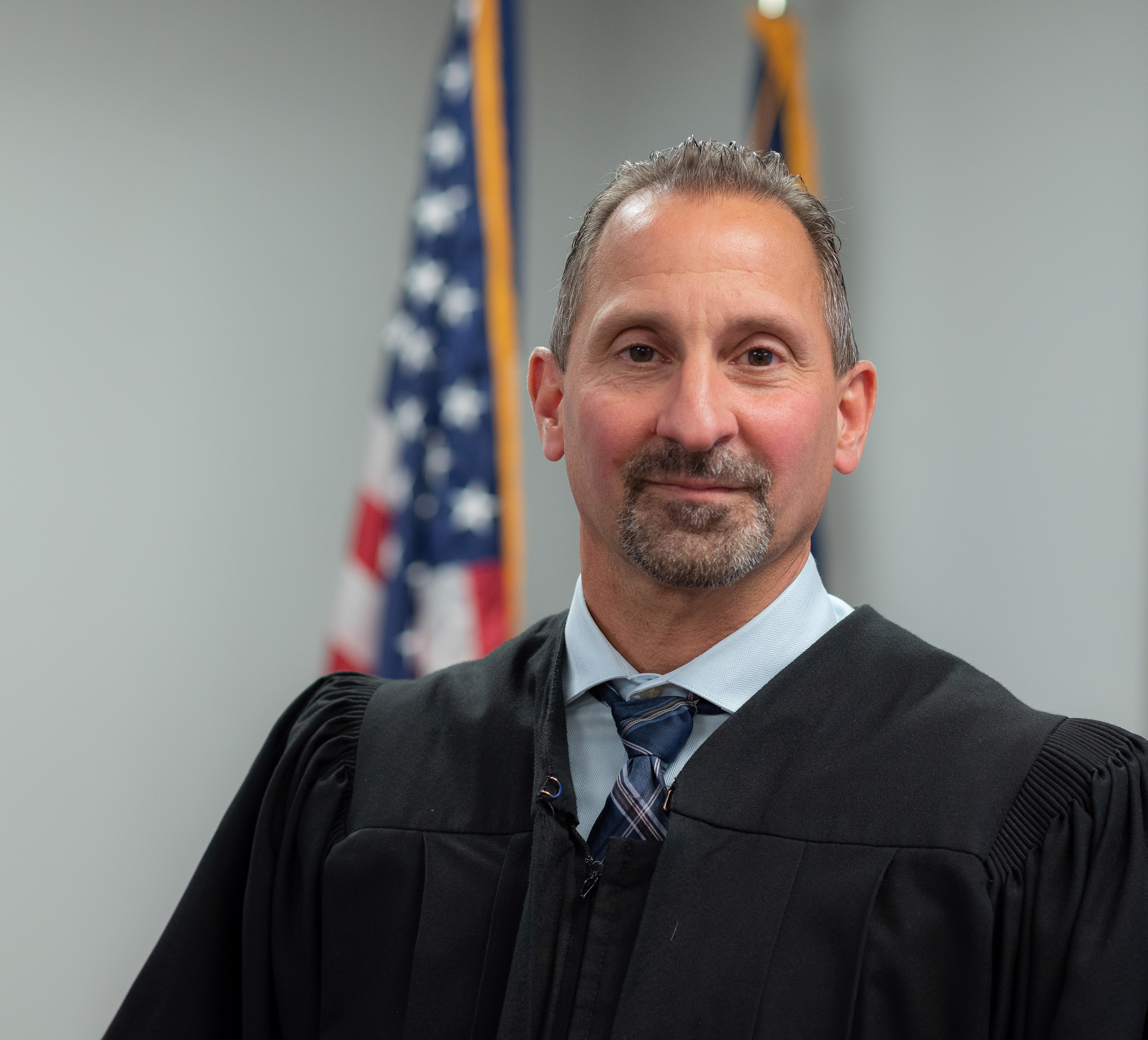
"I'm here as a clean slate, to make judgement on what's before the court....And, if the law and the situation allow me, [I also] do what I can to help."
When Sam went to college at Gannon University in Erie, he stumbled on the Criminal Law major—six other guys on his dorm hallway were majoring in it. With the mentoring of two professors, Tom Leonardi and Judge John Bozza, he became a serious student of the subject. He thought about law school as the next step—“my mom begged me to go”---but he didn’t think he could do it. Eventually, he found his own way, getting a job as a probation officer in Crawford County’s Juvenile Probation Office. “I never looked back. I loved it.”
For 24 years he worked in Probation, juvenile and adult, as an officer and later a supervisor. With its emphasis on rehabilitation and public safety, the work tapped into Sam’s social, caretaking nature. He especially enjoyed collaborating with local agencies—the county’s Drug and Alcohol Commission, for example, or the Arc (which works with people with intellectual and developmental disabilities)---to address the needs of probationers in concrete ways. He was learning, too, that the need for help was endless.
“We’ve got 40 or 50 people sleeping in tents by the river. Sometimes more!” In his years at Probation and now in his time on the bench, he’s tried to help people avoid homelessness. “People are just surviving,” he says. “The totality of a population will not thrive if we’re only surviving. If you’re only surviving, you will not overcome your illness—physical or mental—or your drug and alcohol addiction.”
When Sam became a magistrate, the transition wasn’t simple. There was the matter of getting elected and two hurdles before that. Officers of the court cannot be involved in politics, so he had to quit his job in Probation before campaigning for a judgeship. Because he was not a member of the Pennsylvania Bar, he also had to take, on his own nickel, a four-week intensive Certification Course of Instruction in Harrisburg and then pass a notoriously difficult four-hour qualifying exam. But with Christi’s encouragement, he was, as he says, “all in.”
Then, as Sam started the third week of the course, his mother’s doctors in Meadville discovered cancer in her lower intestine. They operated right away. Sam’s siblings, Mike and Patti, were there, but he was stuck in Harrisburg, four hours away. He called Chris Weibel, his mom’s surgeon, later that day. The news wasn’t good. The cancer had spread to her liver. Chris couldn’t predict how long she had. He told Sam, “you just make sure you pass that test and you get home.” Weeks later, when Sam received the letter saying he’d passed the exam, he took it to his mother. He recalls the moment. “I said, ‘look Mom, I passed!’ She was so happy. She said, ‘I can’t wait to see you in your robe!’ She passed away in October.” And Sam was sworn in January 4th.
“So she missed it,” I say.
“Oh, she still saw it.”
You’d think Sam would have lost his buoyancy at some point, given the suffering, malign behavior, and misfortune he encounters every day. The effects of addiction and mental health crises alone “are staggering,” he says, accounting for most of the courts’ and law enforcement’s efforts. “No one wants to be an addict,” he quickly adds. There are other, quieter signs of community decline, too, that might get a person down. Most of the relatives in Sam’s generation have moved away. Four years ago, in the face of dwindling attendance (and the pandemic), the three Catholic parishes in town consolidated into one and St. Mary’s no longer holds mass. Sam’s great-aunt’s house across the street is gone, its footprint occupied by the Crawford County Assistance Office. And East End school closed a dozen years ago.
But down isn’t on Sam’s compass. Other parts of life help, too. His and Christi’s daughter Francesca, a speech pathologist in New Hampshire, got married in May (Sam helped preside at the ceremony); and Nick, their son, works in HR for the Tennessee Department of Revenue. Both love helping people, he says. Go figure.
Meanwhile, Sam still works his contacts at local agencies, often making attendance at a program a person needs a condition of their bail (in lieu of the money they don’t have). Every thirty days, at “payment determination hearings,” he then verifies their attendance. The monthly check-ins are a sign of how easily frayed lives can unravel, but they’re a sign, too, that Sam Pendolino is keeping faith—with individuals before the court, and with the humanity of his own work. So much to make a mother proud.
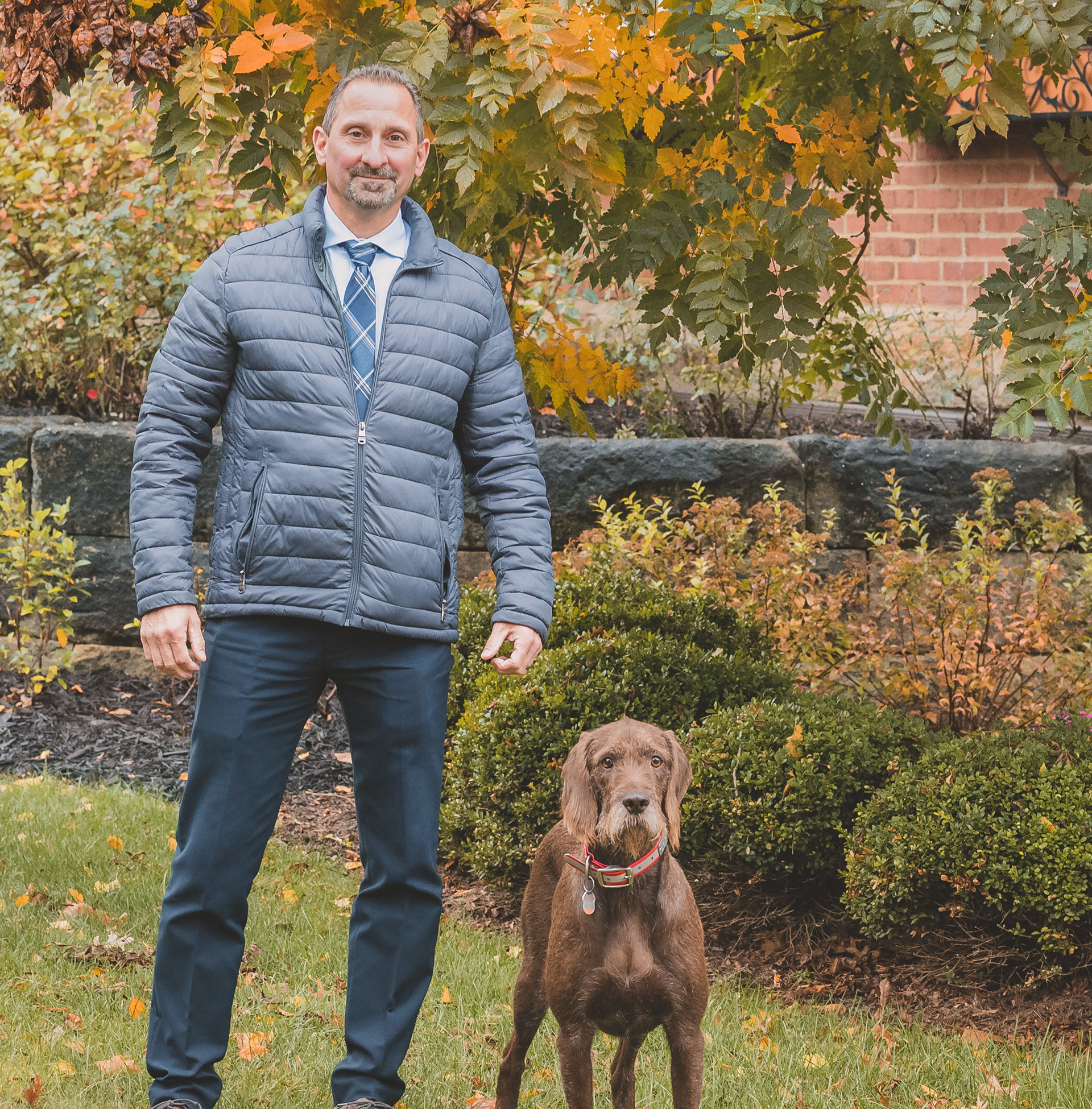
Sam with his trusty hunting dog, Stella.